
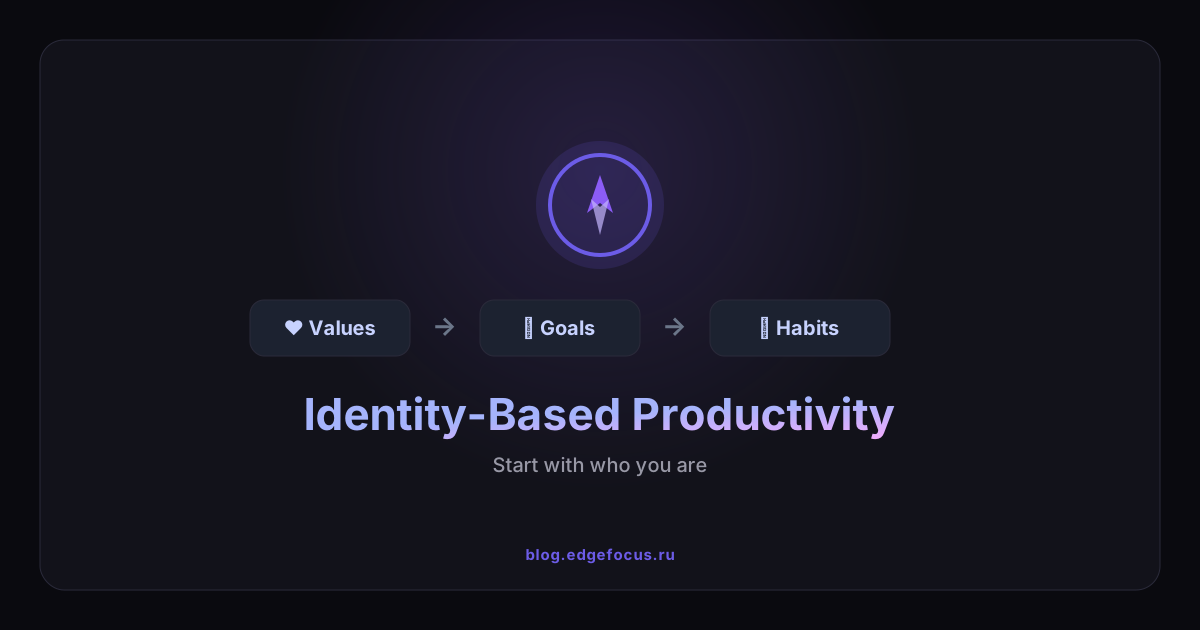
Most productivity tools start with the wrong question. They ask: what do you want to achieve? You write down a goal — ship the product, lose ten kilos, read more — and the tool dutifully tracks it. Then, a few weeks later, the goal quietly dies. Not because you stopped wanting it. Because nothing in your day was structured around being the kind of person who does it.
This is the gap EdgeFocus Compass was built to close.
Goals are a destination. Identity is the engine.
James Clear put it best: you do not rise to the level of your goals, you fall to the level of your systems. A goal is a one-time outcome. A system is what you do every day. And the most durable system isn’t willpower — it’s identity. People who keep a habit don’t think “I’m trying to run.” They think “I’m a runner.” The behavior follows the self-image, not the other way around.
Compass makes that cascade explicit and visible:
- Values — who you are. Identity anchors, phrased as “I am someone who…”. Health. Mastery. Freedom. The handful of things that, if you lived them fully, would make you proud of the person you became.
- Goals — where you’re headed. Directed outcomes that serve one or more values. A goal without a value is rudderless.
- Micro-habits — the daily system. Tiny, repeatable actions that express a value (and optionally advance a goal). A habit without a value is just a chore.
Most apps give you one of these three in isolation: a goal app, or a habit tracker, or a journal of values you wrote once and never reopened. Compass makes the connection the product. The board is organized by value; under each value sit its goals (with progress) and its habits (with streaks); and a single number tells you how alive that value is right now.
The setup wizard is an elimination funnel
The fastest way to a useless values list is to brainstorm twenty things you “care about.” Everything matters, so nothing does.
Compass’s guided setup borrows from the Theory of Constraints instead. It runs you through a funnel:
- Goals first. Write your 2–3 biggest goals. (Where am I actually going?)
- Discover the values behind them. Brainstorm ~16 candidate values and tag each with the goal it serves. (Who must I be to get there?)
- Eliminate. In guided rounds, cut the list: 16 → 12 → 8 → a final 3–6. (Kill the noise.)
- Merge. Fold overlapping survivors into one — Longevity and Health become a single anchor. (Consolidate.)
- Micro-habits. Attach the daily actions, each linked to the values it feeds.
You end with a small, sharp set of values you can actually hold in your head — not a wish-list, a constraint set.
Alignment: the one number that tells the truth
Here’s the problem with streaks alone: you can have a 40-day streak on a habit that no longer points anywhere. And here’s the problem with goal progress alone: it’s a lagging indicator — by the time it moves, you’ve already done the work (or already drifted).
Compass blends both. For each value, the alignment score is:
50% the average progress of that value’s active goals + 50% the 7-day completion rate of its habits.
That mix is deliberate. Goals are direction; habits are the system. A value scores high only when both are present — you know where you’re going and you’re casting daily votes to get there. When a value cools off, alignment drops, and you see it on the board before it becomes a month of drift. One glance answers the question almost no tool asks: how aligned is my life with who I said I wanted to be?
Every check-in is a vote
Day to day, Compass is quiet. You open the board, tap the circle next to a micro-habit, and it lights up. Your streak grows, the trailing seven-day strip fills in, and the value’s alignment ring nudges up. That’s the whole ritual — a few seconds.
The point isn’t the streak. The point is what the streak represents. Tiny actions are cheap, which is exactly why they compound: “read one page” is too small to fail and too frequent not to add up. Each check-in is a small piece of evidence that you are, in fact, the person in your identity statement. Miss a day — fine. Just don’t miss twice.
Where Compass fits — and where it honestly doesn’t yet
Compass is a deliberate part of EdgeFocus’s wider philosophy. EdgeFocus exists to remove the single thing blocking the most work — stop prioritizing, start unblocking — and at the level of a life, the thing most often blocking progress isn’t a task. It’s a fuzzy sense of who you’re trying to become. Compass is the tool for that layer.
What it is not, in this version, is automatically wired into your task list. Compass is its own meaning layer that sits alongside your projects and tasks rather than inside them. Linking habits to tasks and goals to projects is on the roadmap — but we’d rather under-promise than have you discover the seam later. What ships today is the full identity system: values, goals, micro-habits, check-ins, streaks, and the alignment score, in English and Russian, on web and as an installable phone app.
The deeper bet behind EdgeFocus is that your work, your health, and your direction shouldn’t live in three different apps that never talk to each other. Compass is the part that holds the direction. Start there — with three values, two goals, and one tiny habit — and let the system do the remembering.